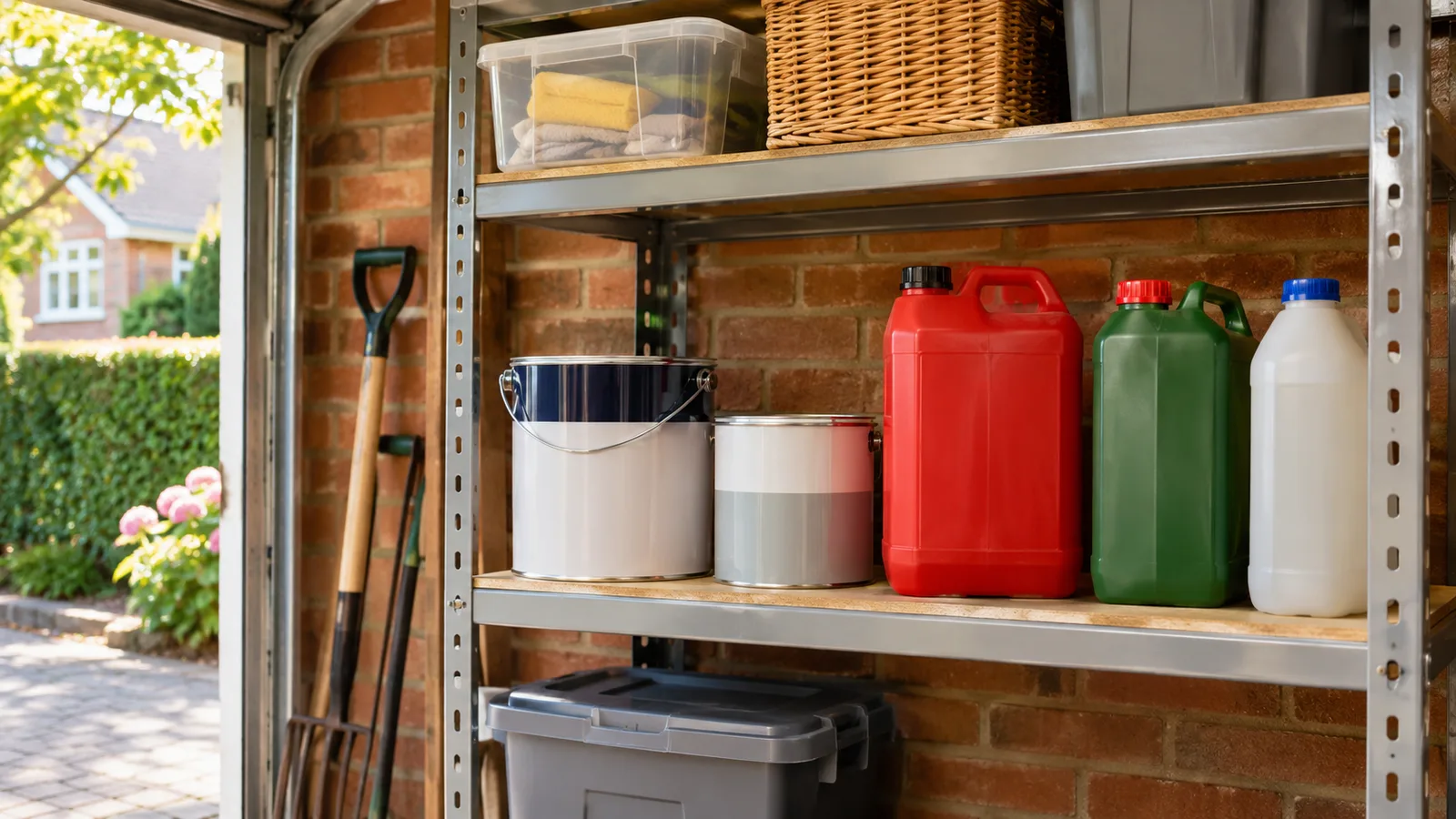
Paint, fuel and household chemicals need storage that follows each product's label and the manufacturer's guidance. Keep products in their original, closed containers and away from children, pets, heat and ignition sources as directed. A garage or shed is not automatically suitable for every substance, especially where temperatures fluctuate.
This is general information, not a substitute for a product's safety instructions or specialist advice. Garage & Storage Cleanouts does not handle, move or organise paint, fuel or chemicals as part of its service.
Why do storage instructions matter?
Different products have different risks. A container that seems ordinary may be flammable, irritating, corrosive or sensitive to heat and freezing. You cannot judge safe storage by appearance alone.
Read the original label before deciding where a product belongs. If the instructions are missing, damaged or unclear, seek advice from the manufacturer or an appropriate local authority rather than guessing. Never transfer substances into food or drink bottles, and never mix leftovers.
Check any warning symbols and follow the specific instructions for ventilation, temperature and separation from incompatible materials. Do not assume that the same arrangement works for paint, fuels, pesticides, batteries and general cleaning products.
Is it safe to keep paint in a garage or shed?
It depends on the type of paint and the conditions specified by its manufacturer. Some products are affected by frost or excessive heat, while others have flammability warnings. A shed that becomes very cold in winter or hot in summer may be unsuitable.
Keep products sealed in their original packaging, according to label instructions. Avoid storing them where containers might be knocked over or reached by children. If a tin is leaking, badly damaged or has an uncertain identity, do not attempt to clean, repackage or move its contents yourself.
For unwanted products, consult your council's current household guidance. Garage & Storage Cleanouts does not transport or dispose of these materials.
What about fuel and other flammable products?
Flammable liquids require particular care. Their labels and relevant UK safety guidance take priority over any generic storage tip. Avoid heat and ignition sources, and do not assume that a normal domestic storage cupboard is appropriate.
If you are unsure about the suitability of a location or container, ask the manufacturer or a qualified specialist. Do not pour, transfer or combine fuels as part of an organising project. Products that appear damaged, swollen or leaking should be left undisturbed while you seek appropriate advice.
General advice from the Health and Safety Executive can help explain fire and explosion risks, but the exact requirements depend on the substance and circumstances.
How should household cleaning products be stored?
Follow the original label for each item. Keep products in their own closed containers and away from children and pets. Do not combine half-used bottles simply to save shelf space. Read the manufacturer guidance on keeping particular substances apart.
Use this decision checklist before choosing a location:
- Can you identify the product and read its complete label?
- Does the label permit storage in that type of space?
- Are the temperature and ventilation conditions suitable?
- Can the container remain secure, upright and inaccessible to children?
- Is there any damage, leakage or uncertainty that requires specialist advice?
If you cannot answer confidently, pause and seek guidance. Do not treat this checklist as permission to handle an unfamiliar product.
What if you find an old or unlabelled container?
Do not smell, open or pour it out to identify its contents. Keep people away from a suspicious container and seek suitable guidance. Your local council can explain its current approach to household hazardous materials; follow their published instructions rather than assuming collection or acceptance arrangements.
For a routine garage tidy, you can work safely around the area without touching the container, provided the wider space is safe to enter. Our garage cleaning checklist covers ordinary dust and accessible surfaces only. Our garage organisation guide focuses on non-hazardous belongings.
How can you plan a safer garage reset?
Identify any products you should leave alone before moving boxes or sweeping. Keep general household belongings in sensible zones using existing stable storage, without shifting containers that need specialist care. If the space contains a spill, strong fumes or another immediate danger, leave the area and seek appropriate emergency or specialist advice.
Our how-it-works page explains the boundaries of the cleaning and organising service so you can decide whether it fits your needs.
Key takeaways
- Product labels and manufacturer guidance come first.
- Original, closed containers are important.
- Temperature, ventilation and ignition risks vary by product.
- Never mix, decant or investigate unknown substances.
- Seek council or specialist guidance where necessary.
Common questions
Can I store every household chemical in the same cupboard?
No. Requirements differ. Follow each label and seek advice about compatibility where needed.
What should I do with an unlabelled bottle?
Do not open or test it. Seek appropriate advice before taking any action.
Will Garage & Storage Cleanouts move chemical containers?
No. Paint, fuel, chemicals and other hazardous materials are outside our service.
For ordinary belongings, Garage & Storage Cleanouts helps West Midlands homeowners empty manageable items, clean accessible areas, organise and put everything back. Packages start from £99; other work is individually quoted. You can request a free quote for a suitable general cleaning and organising project.